Key Features
- 6.22 GHz bandwidth
- No video compression
- Up to 160x160 duplex matrix
- Hot swappable redundant power supplies
- Hot swappable I/O cards and SFP modules
- Standalone and rack mount TX/RX modules
- EDID learning in TX module
- Simplex or duplex operation
- Single or multimode fiber
- Single and dual-link DVI, RGB and 3G/HD-SDI
- Robust 24/7 operation
- Graphical user interface via web browser
Product Links
Opto
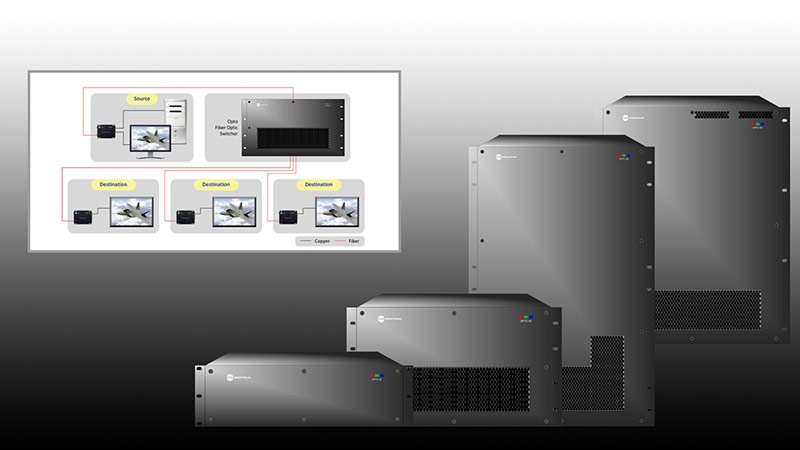
The Opto™ series of fiber optic based products includes enterprise level matrix switchers, transmit and receive modules and related accessories. Signal distribution via optical fiber offers a number of advantages over copper based transmission, including distances up to 40 km, secure transmission, and no-compromise signal quality. Opto modules convert between original (native) copper sources - DVI, HDMI, RGB and 3G/HD-SDI - and single mode or multimode fiber. Optionally, dual-link DVI, audio, and serial or network data can be accommodated. Audio and data are combined with the video and transmitted over a single fiber.
Unlike competitive fiber matrix switchers, 6.22 GHz transmission bandwidth ensures that signals with high pixel clock rates up to 1920x1200 and 2048x1152 can be transmitted without the need for frame dropping or other artifact-causing compression schemes.
Three chassis sizes accommodate systems up to 160x160 duplex and each offers considerable flexibility. Duplex and simplex connections as well as multi-mode and single-mode fiber I/O may be mixed within a frame. Additional I/O cards can easily be added to a short loaded frame for system expansion. Controller and I/O cards, SFPs, fan assemblies, and power supplies are all user-swappable and require no special tools for installation.
System configuration and control are accomplished with the Opto Web Control Panel (WCP) GUI, which can be operated on an optional touch panel or from a computer desktop. Serial and ethernet control by third-party systems is also supported.
Opto fiber matrix switchers provide the user with unprecedented flexibility and a foundation for future development to address the ever evolving requirements of video display systems. An extremely powerful system for control rooms is created when combined with RGB Spectrum’s MultiPoint Control Room Management System (MCMS).
Fiber Matrix Switchers
Opto fiber matrix chassis offers hot-swappable modules, power supplies, optional redundant processor cards, I/O cards and SFPs.
Opto 48
Up to 48x48 simplex or 24x24 duplex matrix. Dual redundant power supplies. 16-channel I/O cards. Optional redundant processor cards and touch panel control.
Opto 80
Up to 80x80 simplex or 40x40 duplex matrix. Dual redundant power supplies. 5-channel I/O cards. Optional redundant processor cards and touch panel control.
Opto 160
Up to 160x160 simplex or duplex matrix. Two separate crosspoints. Dual redundant power supplies. Separate 20-channel input and output cards. Optional redundant processor cards and touch panel control.
Simplex and Duplex Modes
The fiber matrix switcher may be operated in simplex and/or duplex mode. Simplex mode consists of a single channel input and output through the switch, transmitting video and other optional signals from the source to the display.
Duplex mode consists of an input and output channel in each direction travelling over two fiber paths. The input channel transmits video from the source to the display. The Data Display Channel (DDC) carries EDID and HDCP information back from the display to the source. A duplex connection is required for real time EDID and HDCP. In simplex mode an EDID file can be captured and saved in the TX module. HDCP always requires duplex operation. (One-to-one HDCP connections are supported.)
The conversion from electrical to optical signals is performed in an SFP (Small Form Pluggable) module. The way they are connected determines whether a channel through the fiber matrix switcher is simplex or duplex. Duplex and simplex channels can be mixed within a fiber matrix switcher. Each SFP module contains two I/O ports, one for input and one for output. A single module can provide an I/O pair for a simplex channel. A duplex channel requires two modules.
Single Mode vs. Multimode Fiber
The choice of SFP determines whether a channel uses a multimode or single mode fiber. The former is used for distances up to 1000 m; the latter allows runs up to 40 km. The Opto fiber matrix switcher supports a mix of single mode and multimode fiber channels.
Transmit (TX) and Receive (RX) Modules
TX and RX modules convert signals from electrical to optical (TX) and back again (RX). They are available in two form factors:
Standalone Modules
Small form factor modules, for desktop or flush mounting (except the RGB module) which utilizes a half rack size format).
Rack Mount Modules
For cost savings and space efficiency, RX and TX modules are available for a 1 RU enclosure which houses up to four single width modules. Most TX modules include a monitor out port to display a source signal. Most RX modules include two DVI output ports for additional configuration flexibility. Pairs of TX and RX modules can also be used as signal extenders independently of the switcher.
Web Control Panel (WCP)
The Opto WCP is a tool to configure, control and administrate the operations of a single or multiple Opto fiber matrix switcher. This GUI application installs and runs on Linux and Windows PCs, connecting to the Opto chassis via Ethernet. Administrative options allow users to be added and set up in organized groups via easy step-by-step screens. Sources and destinations can be named and EDID priorities selected. Access to sources can be limited to specific users if desired. IP and security settings are managed as well. Built-in routing templates simplify testing and troubleshooting. Macros and log info round out the extensive feature set.