Press Release
press contact: carol marcusdirector, corporate communications
tel: (510) 814-7000
for pictures in 300 dpi format
send request to carol@rgb.com
![]() |
White Paper On A Collaborative Technology Demonstration Between
Industry And The Department Of Homeland Security's
Science And Technology Directorate.
2008 Homeland Security
S&T Stakeholders Conference West
January 14-17, 2008
Los Angeles Convention Center
ABSTRACT:
In October 2007 an idea was born to create a collaborative demonstration between industry and the DHS Science & Technology Directorate. The concept was to apply leading edge COTS (Current Of The Shelf) tools used for Command and Control to support the general session meetings at the January 2008 S&T Stakeholders Conference West.
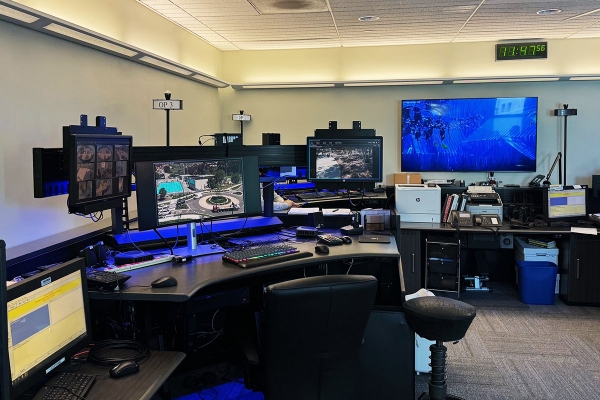
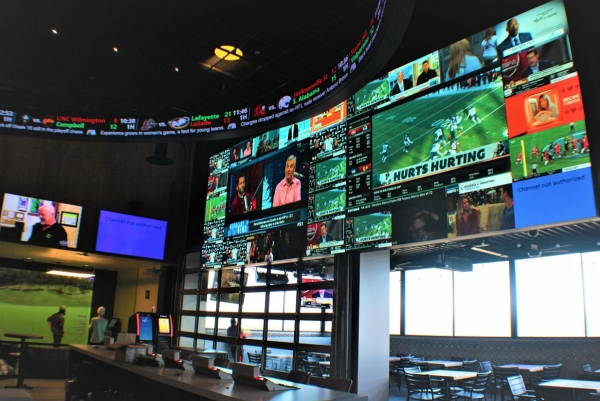
By treating the Plenary Session Hall as a command briefing environment, various media, information sources, formats and data could be fused together for the attendees. This ambitious and dramatic enhancement to the standard PowerPoint presentation required a collaborative effort of leading Command and Control technology providers. The integration of these technologies resulted in THE DHS S&T COMMAND CENTER - a 1,000 person command briefing environment boasting 24.9 million pixels of information with the ability to show up to 36 simultaneous media sources in scalable, separate windows, all managed by a state-of-the-art advanced control station.
DHS S&T: http://www.dhs.gov/xabout/structure/editorial_0530.shtm
THE TECHNOLOGIES
![]() |
The technologies that were brought together included:
A. A three-screen command wall with
B. Extensive "source windowing" capabilities allowing
C. Many computers and media feeds
D. To be selected and displayed using a central command station
Using the command station, the different sources could all be accessed and displayed at-will as separate information windows placed anywhere on any of the screens.
Sources included: Computers with PowerPoint presentations; laptops linked into the Internet; live cameras; proprietary applications linked to restricted networks; and even live satellite links. Any of these could be arranged, sized and laid out into "screen sets" to be stored and recalled with simple mouse clicks. Sometimes sources were called for in real time and placed on the screens in response to events at the podium.
THE BLOCK DIAGRAM
Many organizations spend months and even years planning and implementing a Command Center visual system. In this case, the leading edge, high performance and extremely flexible large-scale system needed to be transformed from "parts and pieces" into a fully functional command center in a day and a half. Good planning and a great technical team put up the basic system in a day. By noon the next day, we were rehearsing with a stabilized, reliable and fully operational command center.
In command center applications, all sources are typically linked into a matrix switcher (A) - a device that can take many video and audio inputs and send them to one or more outputs. The scale and complexity of this varies by facility and by mission.
Below, the outputs from the Matrix Switch (A) are directed into RGB Spectrum MediaWall 2000 units (B). These are the electronic image processors that allow sources to be placed into windows that can be sized, scaled, positioned, labeled, bordered, and more. The outputs of the MediaWall processors are sent to Sony's SXRD 4K projectors (C), each of which has an unprecedented 8.8 million pixel native resolution. This is ideal for command and control, since it allows all the pixels from a number of computers to be displayed at their full native resolution without shrinking or scaling the images down in order to fit the many windows onto the display.
![]() |
RGB Spectrum MediaWall 2000www.rgb.com/en/Products/ViewProduct.asp?product=Mediawall2000
Sony 4K SXRD http://bssc.sel.sony.com/BroadcastandBusiness/minisites/SXRD/visualization.shtml
RESULTS
As is typical with the implementation of any new command center, the full potential of the DHS S&T Command Center far exceeded its inaugural use.
This is not unusual. In most cases, when organizations bring these powerful collaboration tools together, all the technology may be in place and working, but this is only when the magic begins. The real value of large-scale visualization, including command centers is not about technology at all! The value is derived from enhanced "Work Flow", increased "Situational Awareness" and collaborative access to a COP or "Common Operating Picture". The tools of command and control are transformational; they stimulate organizations to transform their processes, because they have access to the tools. The tools do not create the transformation; they simply act as a catalyst and a means for new ways of seeing, understanding and decision-making.
The same holds true for the DHS S&T Command Center. It was used to create the most comprehensive general sessions S&T has had for its Stakeholder meetings. Now, having experienced it, the ideas of what to do and how to leverage such capabilities is stimulating many conversations.
![]() |
Even right out of the gate, the results were highly effective. Throughout the Plenary sessions, presentations were enhanced with screen sets that not only supported the presenters directly (PowerPoint and image magnification) but also provided contextual information by bringing different types of media into the communication.
For example, during presentations about California's first responders and the response to the big fires of 2007, the presentation was enhanced with dramatic imagery that provided a real sense of the scale of the emergency and of the responders in action addressing it.
It is important to note that, unlike a major corporate meeting event, none of this was "pre-produced". S&T staffers simply gathered and organized resources and data - images, websites, videos, maps - and then brought them together into an "information pool".
![]() |
All the integration of presentations and supporting media was accessed and put together on the fly. There was no pre-production, nor were there designers, show producers and media production companies involved. It all came together by access to organized resources and bringing them on-line in real-time as dictated by the situation, the opportunity or by real-time request. This IS command and control!
As stated previously, a Command Center's core purpose is to provide enhanced situational awareness to decision makers. In today's media rich world, this means you want to be able to access information quickly and instinctively.
Sometimes this is accomplished through integrated data solutions such as Anaheim's EVOC(Enterprise Virtual Operations Center) presented by Tom Wood, Anaheim's Assistant City Manager/COO. Mr. Wood showed the city's impressive data fusion implementation, which integrates first responder operational and incident information, city/regional situational information, law enforcement intelligence, technical reference information, breaking news capsules and more into a composite information system accessible and shareable by the entire first responder community in that city.
Most communities have not achieved such a comprehensive integration of their first responder resources. When an integrated solution is not yet available, there is a very immediate and effective answer to creating a COP (Common Operating Picture) using these same command center technologies. Fusing non-integrated and disparate information streams on command screens using windowing technologies is an immediately implementable solution. Although not as comprehendible and, more importantly, as distributable as the EVOC, smaller versions of the DHS S&T Command Center can provide rapid integration of data resources by bringing them together as related images rather than integrated data.
![]() |
Geographical Information Systems (GIS) allow users to connect dynamic data to its geographical location. Many important examples of this were shown throughout the event - whether public tools like Google Earth or Microsoft Virtual Earth or proprietary GIS applications such as Reality Mobile.
EVOC http://www.anaheim.net/administration/PIO/news.asp?id=425
Google Earth http://earth.google.com
![]() |
Their Reality Vision system combines off-the-shelf media phones and GIS technology to provide new capabilities for collaborative group vision of situations.
Future Concepts showed their mobile command centers supported by their Anteres GIS based command software , which extends the users view across three data screens.
And a new web service that allows users to build slide show style sequences of web sites debuted on the big screens of the DHS S&T Command Center.
On the third day of the event, Undersecretary Cohen use the Command Center to take the entire audience on an interactive satellite link visit to Stowe Vermont, where media host Bob Arnot interviewed the local chief on what the First Responder concerns and issues are in his city.
![]() |
The audience was also treated to a real time visit to a first responder exercise from the Los Angeles Regional Common Operating Picture Program (LARCOPP) held by the Los Angeles Sheriff's Department. Using a combination of satellite uplink, IP encoding, web access and cell phone technology, the audience visited the LARCOPP exercise in progress.
All in all, the DHS S&T Command Center did exactly what it was intended to do - bring more information to the participants - audience and presenters alike - sometimes anticipated, sometimes not.
For example, in the midst of one presentation, a panel member mentioned that he really wished he had a map of the BART (Bay Area Rapid Transit) system to support a point he was trying to make. Moments later, the map had been Googled, located and brought to the big screens to support his commentary.
This interactive process between presenters, audience, data sources, data management and situation (the event in this case) was a great example of using command and control tools to explore, discuss and achieve an enhanced understanding and collaboration among the attendees of the DHS S&T Stakeholder Conference West.
Microsoft Virtual Earth http://www.microsoft.com/virtualearth/default.aspx
Reality Mobile http://www.realitymobile.com/
Future Concepts http://www.futureconcepts.net/index.html
Site Sequencer http://www.sitesequencer.com/
LARCOPP http://www.officer.com/print/Law-Enforcement-Technology/Creating-a-common-operating-picture/1$37896
COLLABORATION PARTICIPANTS:
The projection technology courtesy of Sony: http://bssc.sel.sony.com/BroadcastandBusiness/minisites/SXRD/visualization.shtml
The windowing / image processing technology courtesy of RGB Spectrum: http://www.rgb.com/en/Products/ViewProduct.asp?product=Mediawall2000
The media staging and technical operation was provided by: http://www.ceavco.com
The DHS S&T Command Center was conceived by the S&T Corporate Communications Team
The project was designed and produced by: Theo Mayer, Senior Technology Advisor - TechApplication.com http://www.techapplication.com
ABOUT THE AUTHOR
Theo Mayer is the former CEO of Panoram Technologies, Inc. Over his 15-year tenure with Panoram, Mr. Mayer helped to define and produce many of the technologies and methodologies that are now considered the standard in collaborative visualization for oil/gas, automotive, aerospace manufacturing, and scientific computing. His reputation for visionary application and integration of off-the-shelf media technologies to help people see more, understand better and therefore make better and faster decisions spans a number of industries and continents. Starting in 2000, Mr. Mayer began to bring these same application engineering precepts into the command and control world.
Today Mr. Mayer is an independent technology advisor to both the technology suppliers as well as the user communities.
Contact:
![]() |
Theo Mayer
Senior Technology Advisor
theo.mayer@techapplication.com
Voice: 818 535 1326
® 2008, Theo Mayer - All Rights Reserved. Images courtesy of techapplication.com. Department of Homeland Security, Google Earth, Reality Mobile, Bay Area Transit Authority. All names, brandnames, tradenames, and trademarks are the exclusive property of their respective owners.
RGB Spectrum® is a leading designer and manufacturer of videographic and multimedia hardware subsystems. Products include the View™ family of video windowing systems, the RGB/Videolink® line of scan converters, The Linx® DVI Matrix Switcher, the DGy™ digital recording system, Quadra® universal scaler and synchronizer, SynchroMaster® keyers and overlayers and ComputerWall® and MediaWall® multi-screen display controllers. RGB Spectrum is based in Alameda, California, and can be reached at 510-814-7000 and on the internet at http://www.rgb.com.